See how AI-ready your website really is.
Enter a public domain and site profile to measure agent readiness and find the fixes needed for an agent-ready website.
Last updated September 1, 2026
Agent-ready SEO essentials
Agent readiness means AI agents can find your canonical pages, interpret what matters, and complete clear next steps without guessing. This homepage focuses on crawl signals, trusted public pages, and action paths that support both search engines and agent workflows.
Trusted by forward-thinking teams



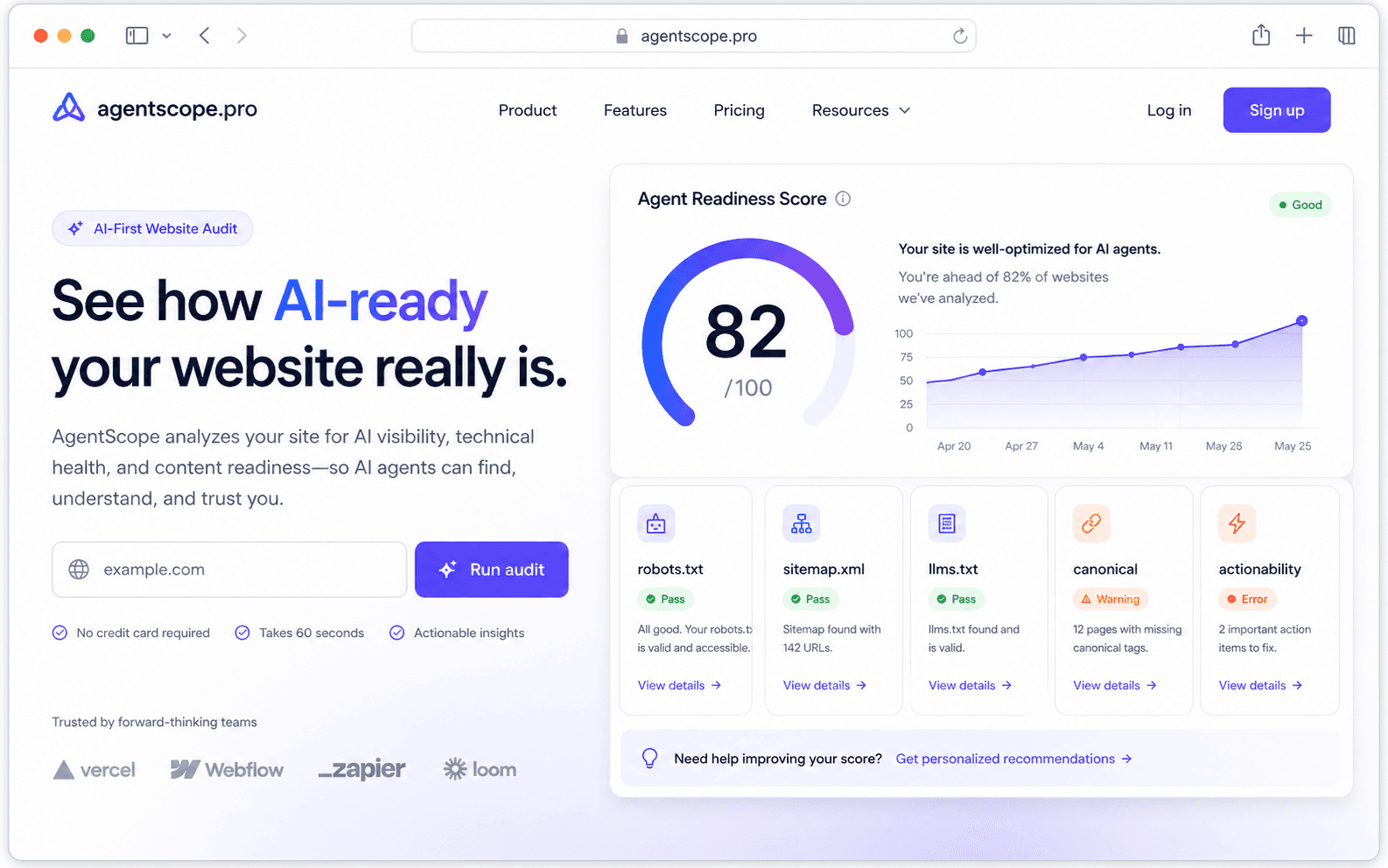
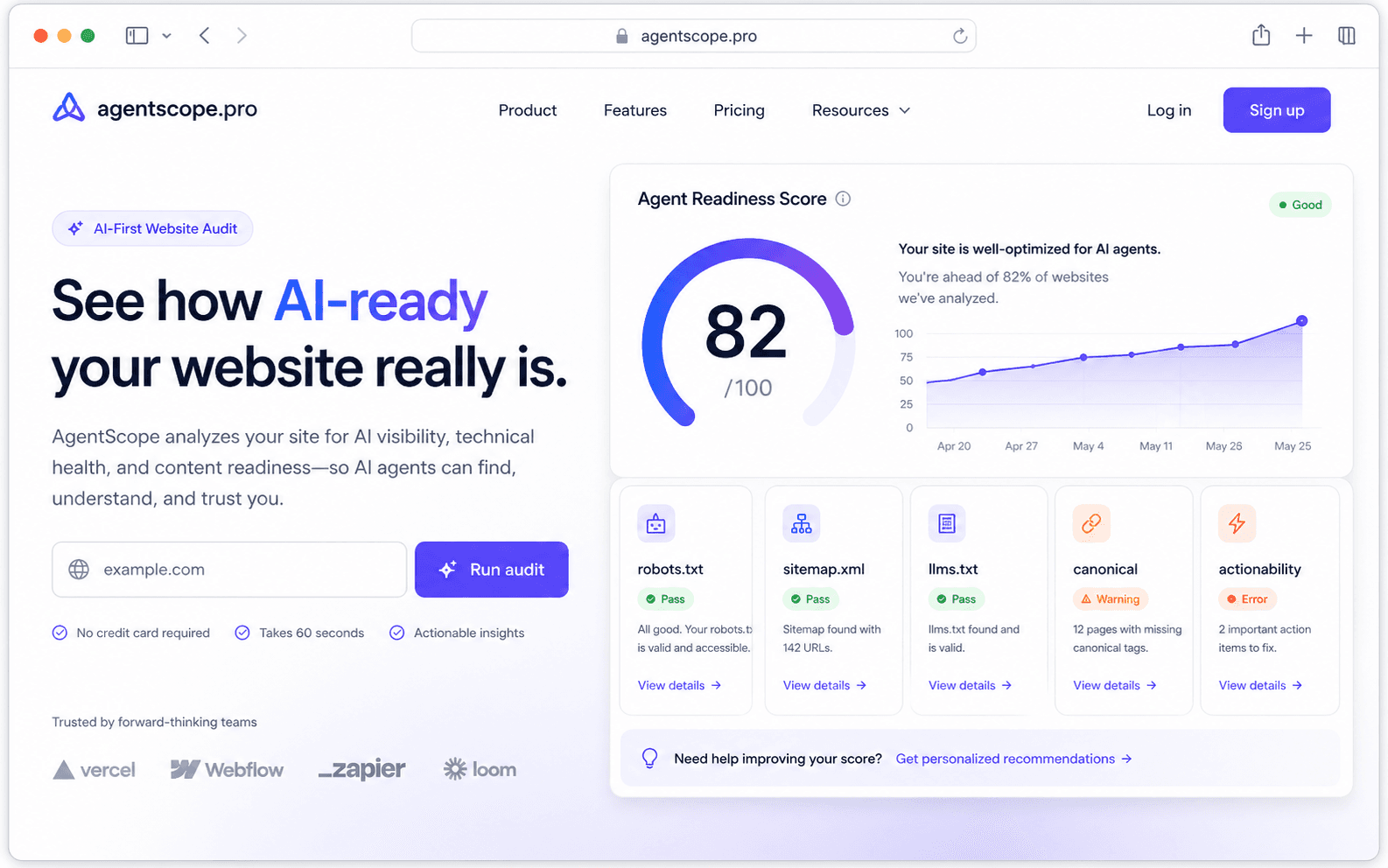
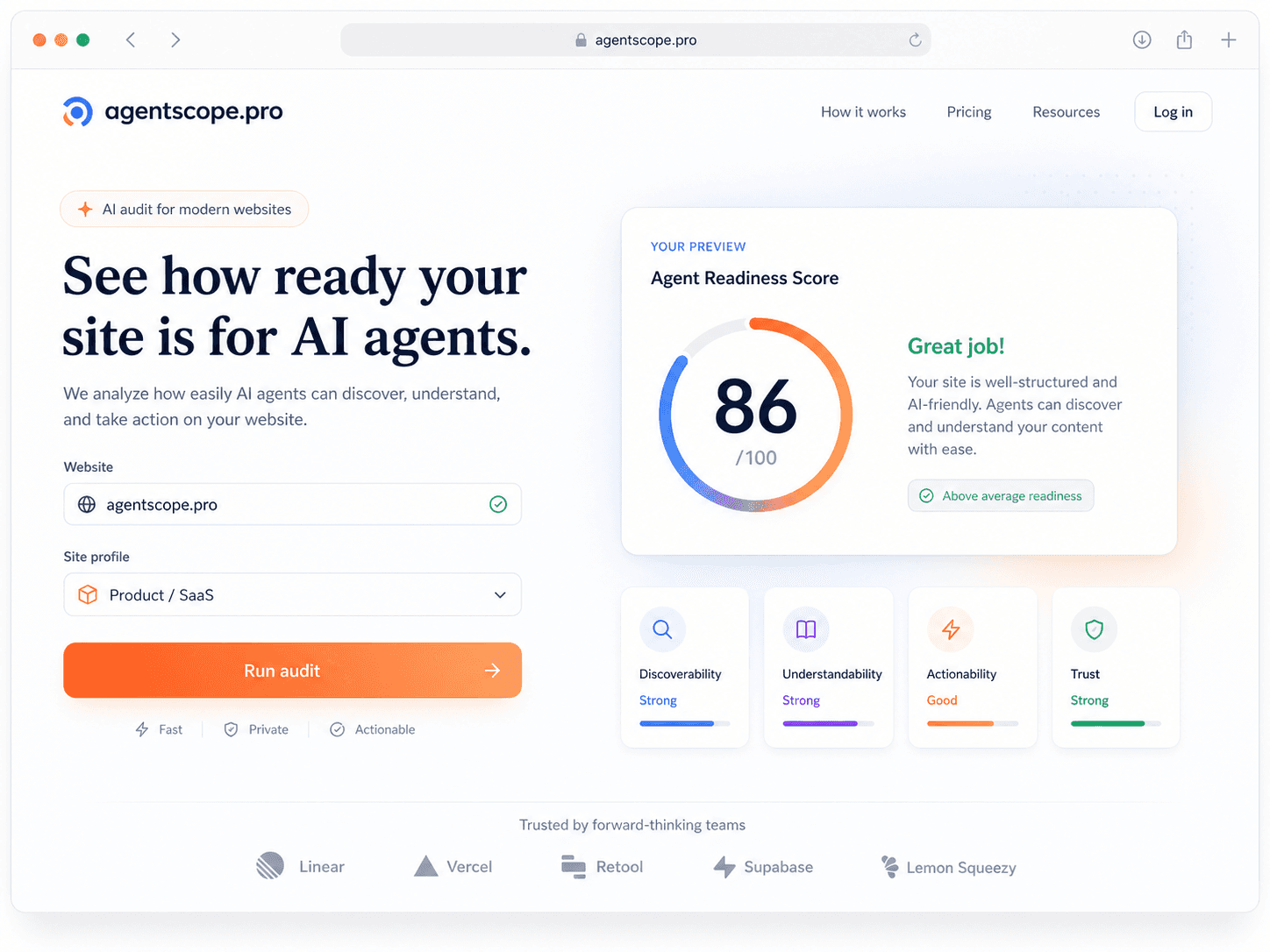
Agent Readiness Score
Preview the audit dashboard before your first scan.
Crawl
robots.txt, sitemap.xml, llms.txt
Score
Discoverability, trust, actionability
Output
Findings, fixes, shareable report
What an agent-ready website needs
Agent readiness means AI agents can find your canonical pages, interpret what matters, and complete clear next steps without guessing. This homepage focuses on crawl signals, trusted public pages, and action paths that support both search engines and agent workflows.
Three steps to improve agent readiness
- 1. Clean up discovery signalsPublish a crawlable robots.txt, keep an accurate sitemap index, and make sure canonical URLs point to live public pages.
- 2. Clarify the action pathExpose pricing, policies, and primary calls to action so agents can move from discovery to an informed recommendation.
- 3. Keep the content freshRefresh key sections, update your last-modified signals, and document important changes so agents can trust the latest version.
How agent readiness differs from generic AI visibility
Readiness is action-oriented
A visibility check stops at discoverability. Agent readiness also tests whether a visitor can reach pricing, policies, and conversion paths.
Readiness prefers canonical sources
Agents need one stable URL for each important page. Canonicals, hreflang, and sitemap discipline reduce contradictory signals.
Readiness supports trustworthy answers
Strong structured data, FAQ answers, and explicit trust pages make it easier for assistants to cite the right page confidently.
What Agent Readiness Score does
This project is a focused audit tool for checking whether public website signals are usable for AI agents. It turns a domain into a score, a prioritized issue list, and clear next-step recommendations.
Scan public AI signals
Review homepage structure, llms.txt, robots.txt, sitemap.xml, and other public entry points that agents rely on.
Score what matters
Summarize readiness across discoverability, understandability, actionability, and trust so teams know what to fix first.
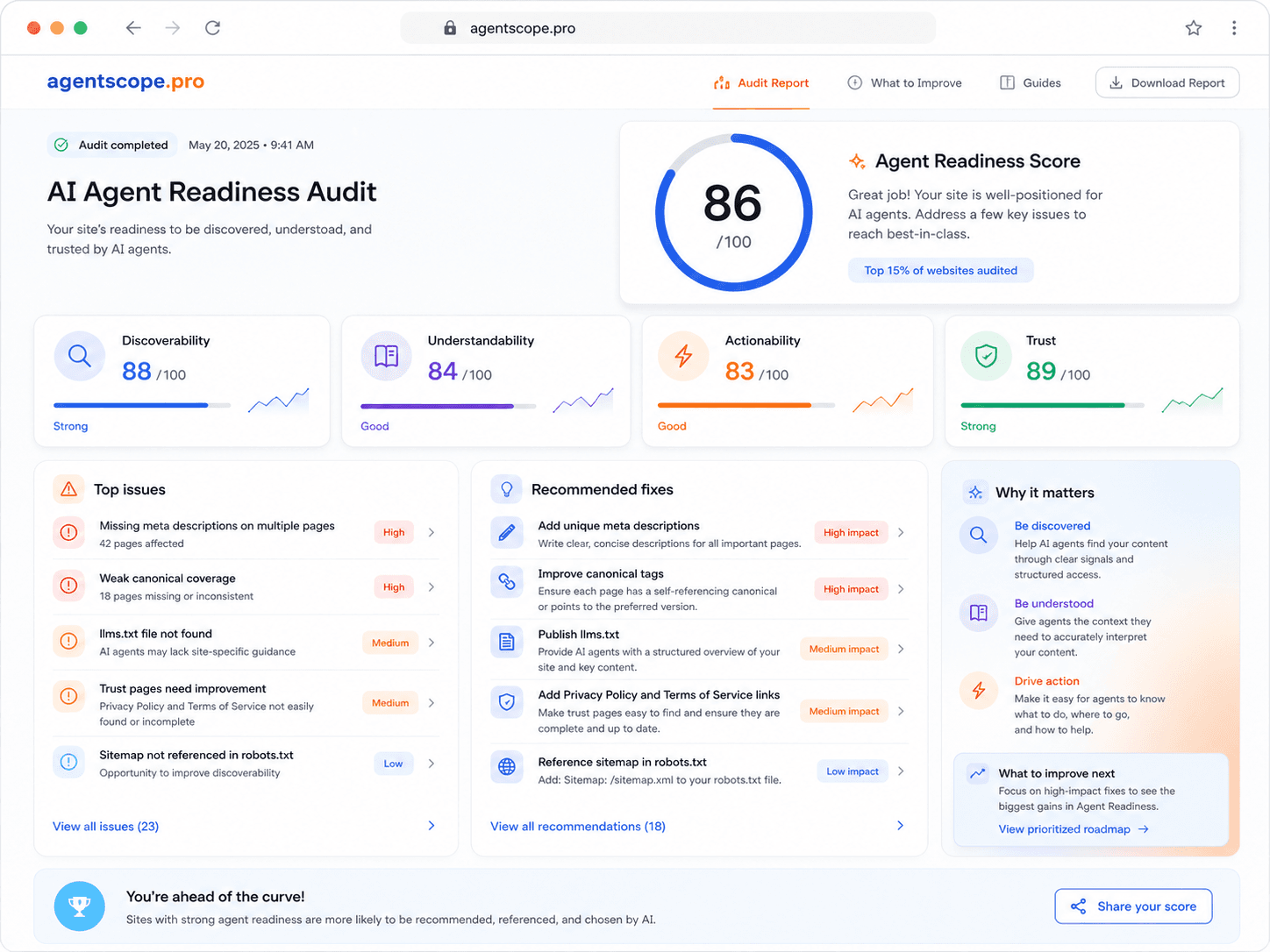
Explain every issue
Each finding should answer what is wrong, why it matters for AI agents, and how to improve the page or configuration.
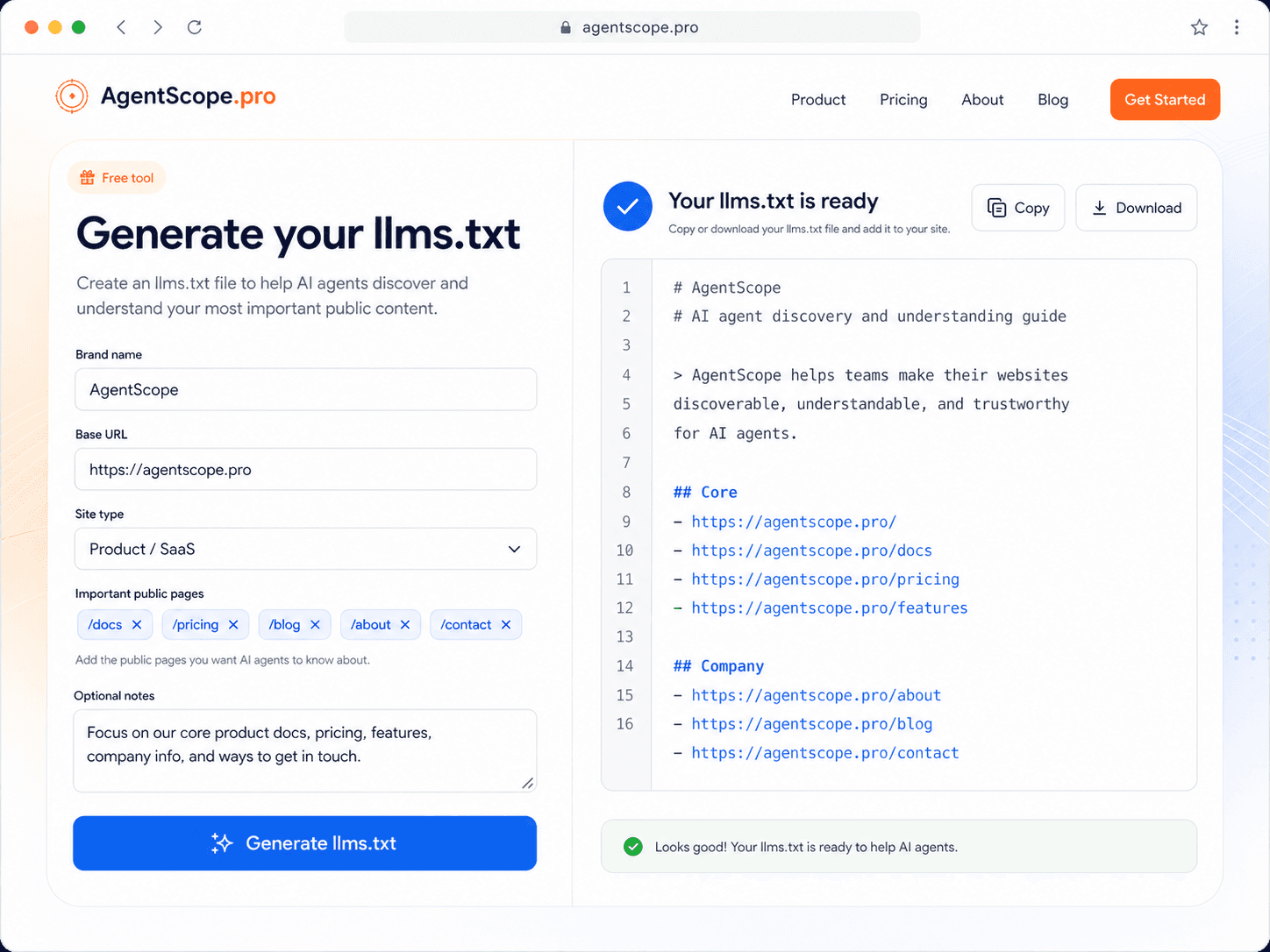
Generate a starter llms.txt
Help teams move faster with a practical template that fits docs sites, blogs, SaaS products, and marketing sites.
Why this approach works for real teams
The product focuses on public, explainable checks instead of opaque monitoring. That makes the audit easier to trust, easier to act on, and easier to share with a wider team.
Low-friction first scan
Users only need a domain to get a first-pass readiness report and a shareable summary.
Explainable output
Scores are backed by concrete findings instead of opaque AI-only summaries, which makes the product easier to trust.
Built for quick iteration
Teams can use the audit now, then expand into recurring scans, exports, history, and deeper workflow guidance as their program matures.
How a scan should feel
Keep the user journey short, clear, and practical.
Enter a domain
Start from a clean domain input with fast validation and normalization.
Run the audit
Fetch the homepage, llms.txt, robots.txt, and sitemap.xml, then evaluate the public signals.
Read the report
Show the total score, four dimensions, high-priority findings, and practical fixes.
Share and improve
Use a public report link or llms.txt draft to push the site toward better agent visibility.
Core checks that improve agent readiness
The homepage stays focused on signals that are easy to explain, easy to validate, and useful to fix quickly.
Domain normalization and safety checks
Accept valid public domains, reject unsupported inputs, and guard against private network targets.
Homepage structure review
Inspect title, description, headings, canonical signals, and navigation clarity.
llms.txt and crawlability checks
Detect whether agents have a direct guidance file and whether crawl signals are discoverable.
robots.txt and sitemap coverage
Verify that machine-readable routes exist and help agents find the important parts of the site.
Action and trust signals
Check whether AI agents can find docs, pricing, sign-up, contact, privacy, and terms pages without guessing.
Shareable report output
Turn findings into a public report URL that users can reopen and share with teammates.
What the product is optimized for
Clear output and practical fixes matter more than noisy complexity.
4 Scoring dimensions
Scoring dimensions
5 Core public resources
Core public resources
1 Shareable report link
Shareable report link
Who this project is for
A practical agent-readiness report is most useful when teams need quick clarity, stakeholder alignment, and a concrete improvement list.
Use a quick public audit to catch missing machine-readable signals before a product launch.
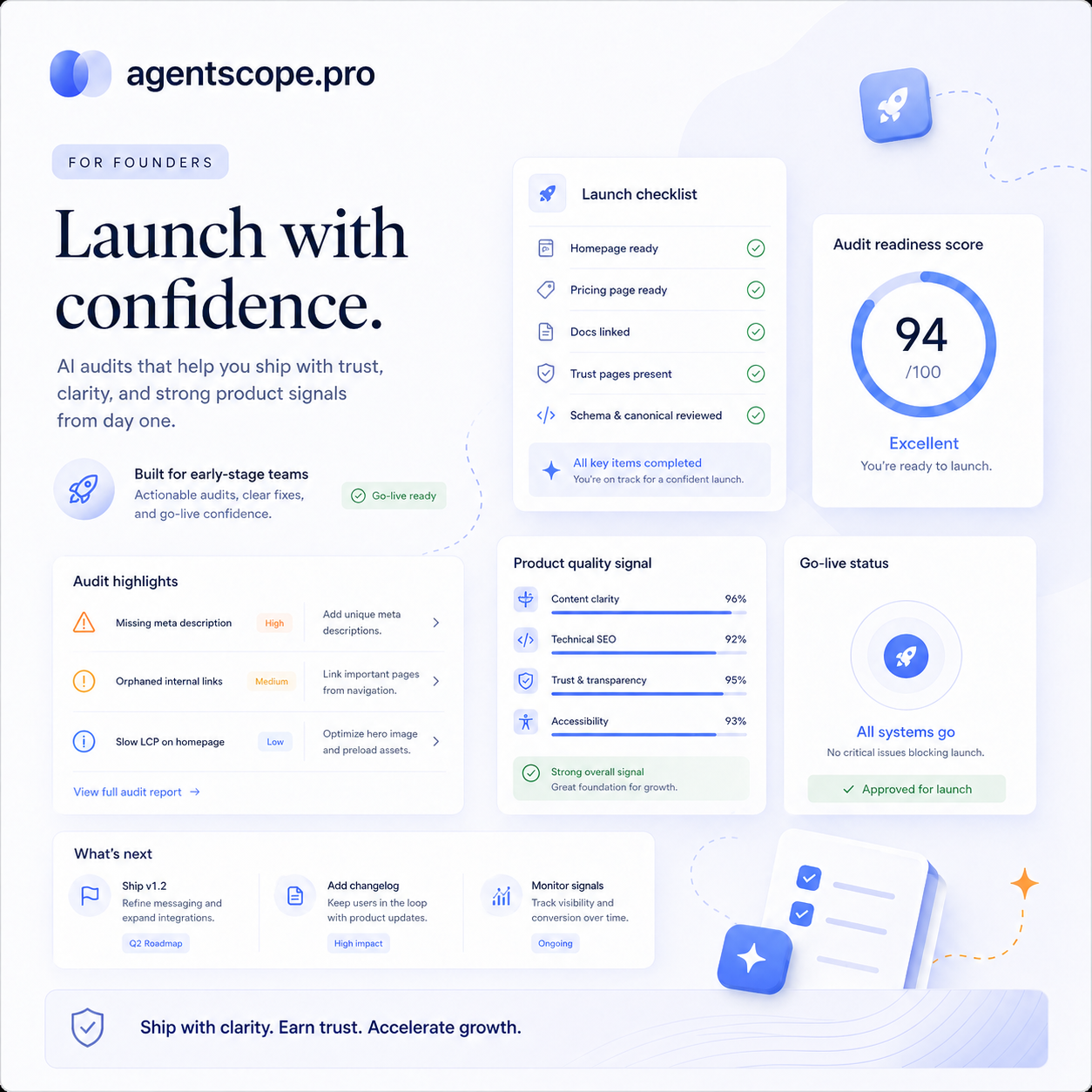
Founders, Launch checklist
Founders
Launch checklist
Find out whether documentation is easy for AI agents to discover, navigate, and cite correctly.
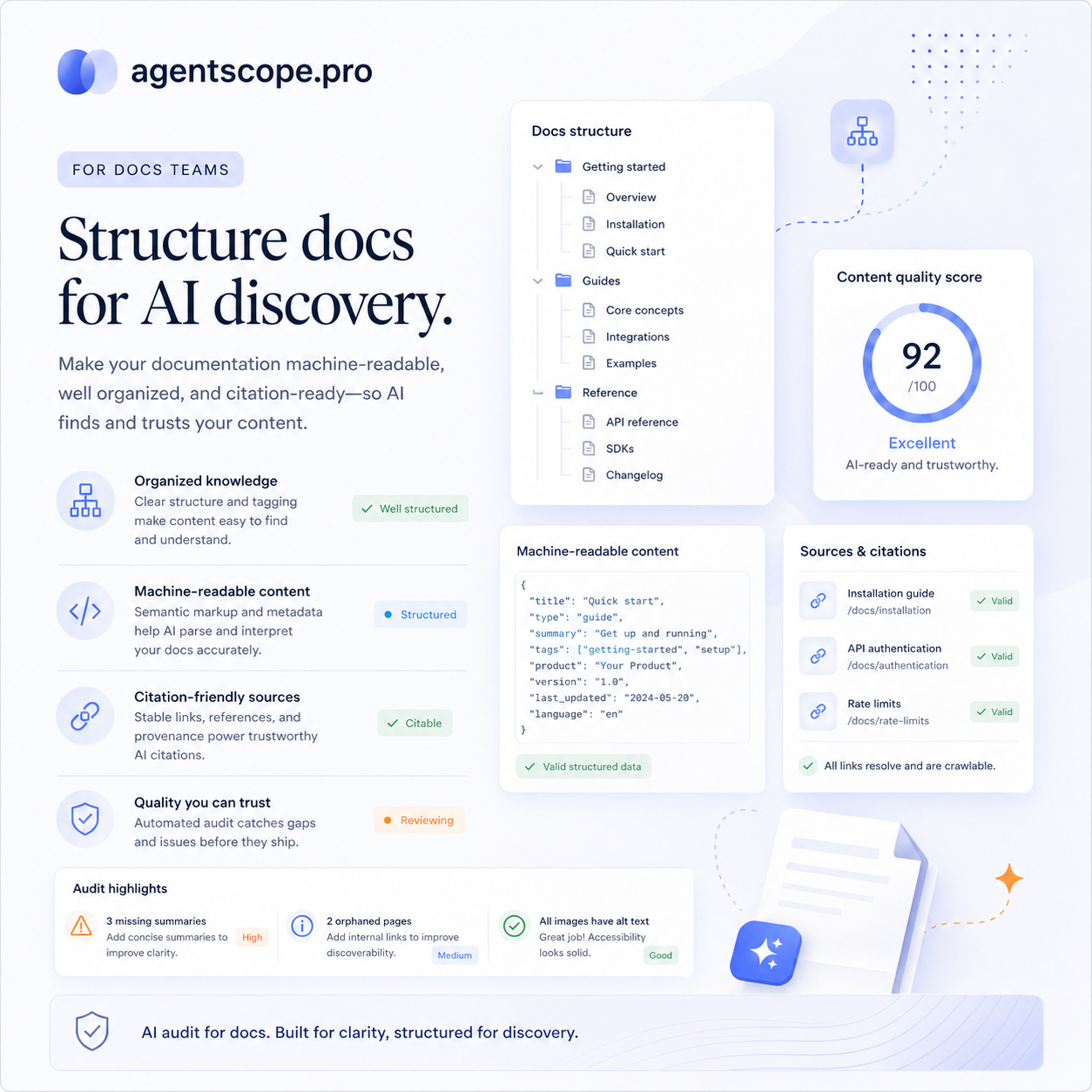
Docs teams, Knowledge visibility
Docs teams
Knowledge visibility
Turn technical checks into a clear scorecard and improvement plan that non-technical clients can understand.
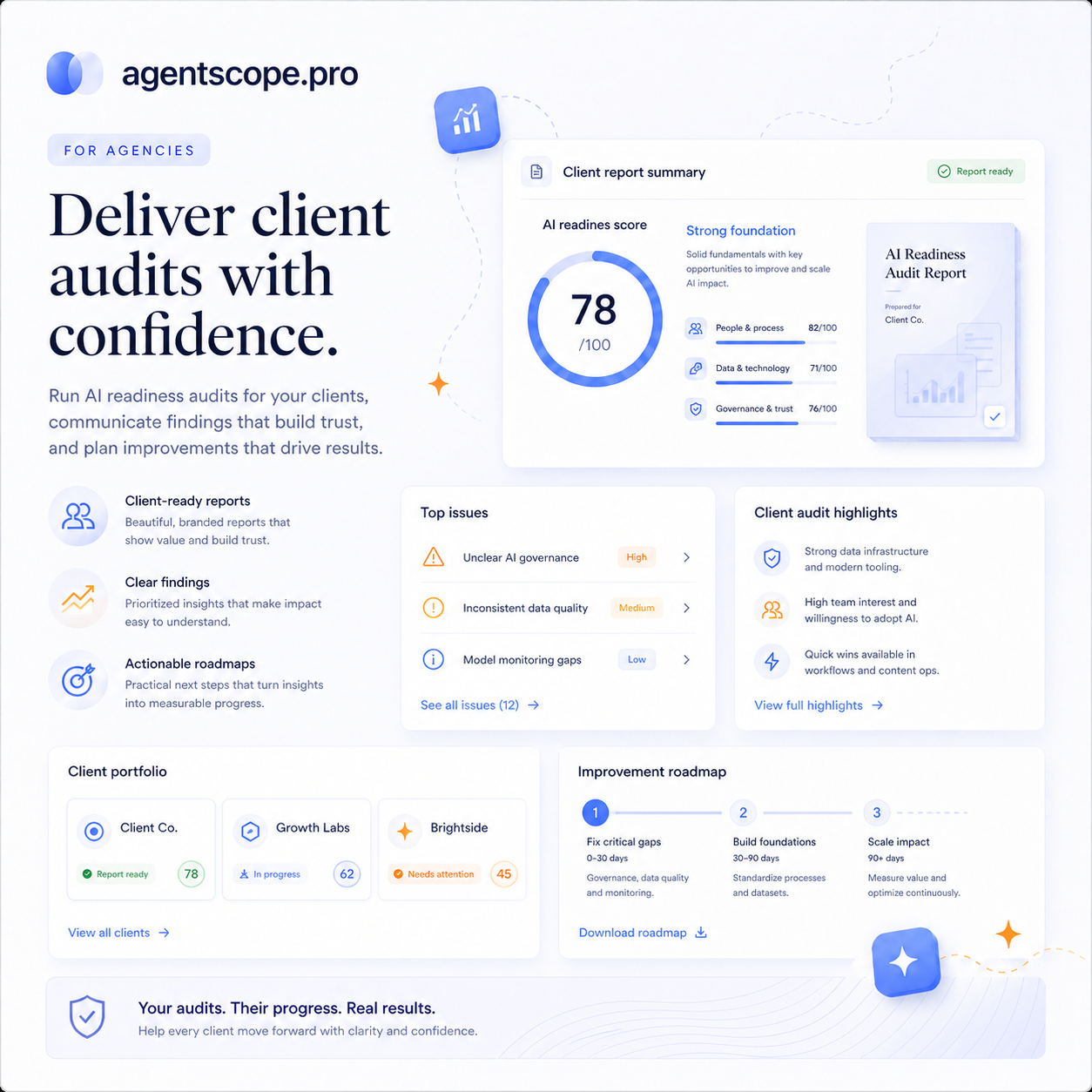
Agencies, Client reporting
Agencies
Client reporting
Frequently asked questions
The product should stay explicit about what it checks and how teams should use the results.
Need a private implementation brief? Start with the audit result, then turn the highest-priority findings into an engineering roadmap.
Start with a clear agent-readiness baseline
Run an audit, review the highest-priority issues, and give your team a clear baseline for improving agent readiness across the site.